Here at GoodGlow.co, we share our acne-fighting and prevention experiences and techniques because we recognize first-hand how frustrating it can be.
Unfortunately, this skin condition is unavoidable for many people, and to make matters worse; many develop scars.
These scars can be challenging to remove or conceal, so we’ve created a guide to cover the most effective ways to deal with those pesky flaws.
Scars can also have a significant emotional impact, making a person self-conscious about his or her skin.
Today, I’ll take you through a variety of methods for fading scars and regaining self-confidence. All of these methods have been scientifically proven to be safe and effective in most cases.
3 Natural Ways To Remove Acne Scars (Natural)
1: Aloe Vera
Aloe vera has been associated with good skin health for quite some time, especially for skin health.
It acts as a healing remedy in the case of acne. Several studies have found that aloe vera reduces inflammation, speeds up healing, and reduces scar size while improving skin texture.
If you happen to already have an aloe vera plant in your home, you can cut a small piece of the plant’s stem and squeeze the gel out of the thrones.
To apply to your face, place a few pea-sized drops on your fingers and gently cover your face, leave it for roughly 15 minutes, and rinse thoroughly.
2: Honey
The second natural remedy to get rid of acne scars is none other than honey. Honey has been utilized for a variety of medical purposes, including allergies, wounds, and burns.
Acne lesions are similar to wounds in that they can take a long time to heal.
They frequently leave scars on the face and can last decades and even a lifetime in some cases. The shorter the time the acne is on your face, the fewer scars it will leave.
Honey has antibacterial qualities that aid in wound healing and cleansing, removing excess oil from pores. It also prevents acne by fighting infection on your face caused by blocked pores.
Regular use of honey can result in clear, scar-free skin. Just make sure to stick with it, implementing it into your daily routine.
3: Black Seed Oil
Many aren’t entirely familiar with the name “black seed oil” because it’s more common in Eastern Europe, the Middle East, and Western Asia.
In recent times, this oil has been thriving in the acne-fighting community, and for a good reason.
This oil is antibacterial, anti-inflammatory, and antiviral. Acne worsens because inflammation and bacteria on the skin cause it.
Black seed oil helps to reduce inflammation and scarring on the skin while also healing damaged skin. Before bed, apply a few drops of oil to the scars and leave it on overnight.
3 Non-Natural Acne Scar Treatments
1: Laser Skin Resurfacing
If acne has left you with numerous scars, blotches, and blemishes on your face, laser skin resurfacing may be an excellent treatment to opt for.
This procedure will help you achieve healthier, more glowing skin by removing acne scars.
It works by eliminating skin layer by layer, which causes new skin cells to be formed during the healing process.
The old scared skin is peeled away, and new, fresh and healthy skin covers the face as a result. However, complete remodeling takes around 18 months.
So it’s not something that will transform your looks overnight, but if you want those scars to be history, this is a great approach to do it.
2: Chemical Peels
Chemical peels are the second most popular method for medically removing acne scars. The process works by resurfacing the skin on the face.
There are three different levels, with each level being better suited for various forms of acne and the amount of damage it’s caused.
The light chemical peel only removes the skin’s outer layer (epidermis). To get rid of acne, it’s repeated every two to five weeks.
The medium peel comes next, which involves removing the upper surface and the middle layers.
Deep chemical peels liquidate skin cells from the deeper layers of the skin and don’t usually need to be repeated.
Aside from redness and swelling, there are typically never any long-lasting side effects.
3: Dermabrasion
Dermabrasion is an exfoliating skin technique that involves removing the skin’s outer layer.
Because it can cause some discomfort, anesthesia is typically utilized to numb your skin before the procedure.
It’s an outpatient procedure, so most of the time, you can go home as soon as it is performed. Despite this, there are a few side effects, such as enlarged pores and skin color changes.
It could take up a few months for your skin to return to normal. Dermabrasion causes pores to enlarge, and the treated skin is frequently temporarily darkened.
4: Facial Cupping
Facial cupping is an ancient skin therapy created by the Egyptians that uses a suction technique to help heal scars, eliminate wrinkles, and promote healing.
Although it sounds weird facial cupping has been around for thousands of years because it helps manage oil production and reduce inflammation in the skin.
In the modern world the two primary uses of facial cupping are to remove acne scars and wrinkles.
The suction from the cups triggers regeneration in the cells and helps improve the production of collagen while also increasing the number of platelets in the blood just beneath the skin to promote healing.
3 Everyday Tips To Avoid Acne Scars
1: Wash Your Face Properly
Keeping your skin clean is the most efficient way to combat acne scars. Throughout the day, dirt particles and various microorganisms become trapped in our skin’s pores.
Furthermore, sebum is produced by our skin throughout the day. Sebaceous glands are more active in some people than others, resulting in oily skin.
Oil and dust particles cling to your skin if it’s not properly cleaned to cause acne. Rinse your face two to three times a day with an oil-free face wash.
First in the morning, then after returning home from work, and finally before returning to work. It will keep the skin clean and hydrated.
The best facial cleanser for acne scars varies based on the type of acne scar and skin type. Everyone has a different skin type and a different depth and severity of acne scars. Our curated list has been used to help fade the acne scars of thousands of people over the last few years.
Additionally, using a face mask after washing your face is a great way to help reduce hyperpigmentation in your skin. If you are interested our team selected several face masks that help reduce the appearance of acne scars.
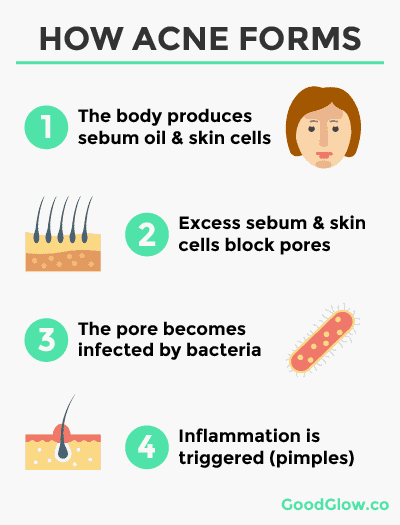
Check out this graphic on how acne forms:
2: Increasing Water Intake
Drinking plenty of water can also help you get rid of and prevent acne scars.
Acne scars are removed by removing the skin’s outer layer. When your body is well hydrated, dead skin cells are shed much more rapidly.
In addition, when you have a lot of water in your body, new skin grows faster and smoother.
Start drinking water regularly; sticking to 8-10 glasses of water per day should be adequate for most people.
3: Food
Implementing a healthy acne diet is an excellent way to combat acne and acne scars.
Food with a low glycemic index and a high protein content can help reduce acne scars while also preventing them.
Acne-friendly foods include sweet potatoes, pumpkin, cauliflower, lemon, salmon, berries, legumes, papaya, quinoa, and kale.
Similarly, try to eat food rich in vitamins and minerals, which help fight bacteria in the skin and restore skin uniformity.

Takeaway
The worst element of acne is that it leaves evidence even after you have fully healed from it. Scars are by far the most distressing aspect of acne for many people.
This is why we felt it was necessary to create a guide outlining how to remove those unsightly scars.
Natural methods such as aloe vera, honey, and black seed oil give your skin a glow; they are inexpensive and readily available.
Chemical and laser skin resurfacing are good ways to remove scars but can cost a fortune. Lastly, look around and see if you can find a dermatologist that offers payment plans.
This can help you get the treatment you need without needing the entire amount upfront.
Frequently Asked Questions about Acne Scars
One of the various prevalent acne scar removal treatments is a laser. It can help in the removal of mild to moderate scars on the face.
It works by removing the skin’s upper damaged layer while tightening the middle layer. The procedure could take a few minutes to several hours, depending on the severity of the scars.
Laser treatments include ablative, non-ablative, and fractionated lasers. The majority of the time, their impact is permanent without needing to return for a follow-up.
However, it’s not always the best for deep scars, as it’s more difficult for the laser to reach that deep.
Acne is not considered a health emergency, and in many cases, is deemed cosmetic, which is frequently not covered by health insurance.
However, some health insurance may cover it. Over-the-counter medications are widely available and often used instead because of the inexpensive price.
As a result, expect to pay $100-$120 per session. On the other hand, some companies allow you to be covered for any procedure performed at a doctor’s clinic.
If the scar is infected, however, it will have a greater chance of being covered.
The price and cost of acne scar removal vary depending on the treatment you choose.
For example, if you look into home remedies or natural ways to heal the skin, you will find that they are very inexpensive, and in some cases, completely free.
The cost of medical treatment can vary depending on the dermatologist and procedure you choose. The average price of chemical peels, for example, is around $699.
Dermabrasion typically costs about $1000. If you intend on doing a lot of work to remove your acne, consider looking into insurance plans that cover some of the expenses if possible.